Sunday, September 12, 2010

The Big Move

Most of August was spent preparing to move out of our house and onto the property. Two obstacles presented themselves: What to do with all of our stuff and getting the travel trailer move-in ready. Both of these proved to validate our two most oft-repeated mottos: “It took longer than expected” and “it cost more than we thought.”

We rented a 8x40 storage unit. Big surprise, it wasn’t big enough. But due to the expert stacking of some good helpers, we managed to fit most of our stuff in it, although we had to stack it—literally—to the ceiling. But despite our best efforts, the day of the move left us with a few extra items, such as the couch, our bed, the fridge, and a couple of my office desks. We found a willing friend to let us stash it in his garage for the time being.

IMG_1856We started the move at 8:00am on August 28th and we finally finished putting these last items in the garage at about 6:00pm. It was a very long and tiring day. But, we cleared our first obstacle.

I thought it was important to prove that my shop could be cleared out, a feat that we had our doubts about.

IMG_1818

The second obstacle required our attention before we moved as we cleaned the outside and attempted to clean the inside of the trailer. We quickly found that the trailer needed more than cleaning.

We bought the trailer from a family who lived in it for two years. There may IMG_1811also been a few goats and dogs in it as well. In light of this multipurpose use, it was in surprising good shape. Still, we felt it necessary to pull out the floor covering, replace the plywood subfloor in a spot in the back that had rotted through, and remove the jackknife sofa to re-upholster it.

Here’s what we’ve fixed in the trailer so far or are in the process of doing:

  1. Fixed subfloor
  2. Installed new carpet in the back and stick-down vinyl tiles in the front.
  3. IMG_1814Removed the dinette booth next to the door and installed a computer desk.
  4. Replaced two of the roof vents, replacing the bathroom vent fan with a “whole-house'” style vent (works great).
  5. IMG_1817Took out all of the window treatments and cleaned them (haven’t put them back in yet and may not because, hey, we’re in the middle of the woods).
  6. Replaced the Wedgewood R2145 stove with an almost new one.
  7. IMG_1819Cleared the kitchen sink drain (it was not draining) and replaced the p-trap under the sink so it doesn’t leak anymore (yeah!)
  8. Repaired about a half-dozen drawers with new or repaired glides so they all work now.
  9. Cleaned all of the windows and screens.
  10. Replaced the cold water supply line to the water heater (I think I sliced it when replacing the back room carpet and didn’t notice it until I turned on the water—which promptly sprayed all over the new carpet. Ugh.
  11. Placed a 200 gallon water tank next to the back of the trailer on a platform so we can easily refill the 40 gallon trailer water tank.
  12. IMG_1813Removed the sofa and we are in the process of repairing the frame and springs (done), cleaning the cover (done), replacing the foam (done), and reassembling everything and installing back into the trailer (to be done this week).
  13. IMG_1825Removed (done) and replaced (to be done this week) all of the heating vent tubes.
  14. Drained the grey water tank into a 4” flexible drain pipe and ran it out a ways from the trailer down hill. (There’s a story in this task, involving a full black water tank with the valve unexpectedly open that includes lots of nasty stuff washing over me. I can’t tell it here because it’s a really dirty story.)

Still to do, which we’ll hopefully do this week:

  • Repair the screen door (replace the screen material and rebuild the bottom of the door, which is basically not there anymore).
  • Patch the roof of several leaks we found deep in the night of our first really big rain storm.
  • Finish installing the bathroom fan trim.
  • Re-install the heater vent tubing.
  • Finish re-upholstering the sofa and re-install back in the trailer.

Then, we can get down to the real business of being out here: Building the cottage.

So, here we are, one week into our adventure. It’s been a long week in some ways. But I think we have gotten the systems working and we can now finish up on the details and move on. It’s a bit cramped, but we manager fine. Our life improved 100-fold when we replaced the leaking air mattress with a new (real) mattress. So now, we can sleep well, take showers, cook, keep things a comfortable temperature, and move forward. IMG_1847

I am fortunate that we can still get DSL. I was told by the phone tech that we are about 24,300 feet from the “Dawson remote”, as he put it, which means that we are just a few feet from the limit and their last DSL customer on the line. I had to accept a lower band width from 1.5Mbs to .5Mbs, but that is not a huge inconvenience. What is a problem is that it keeps going up and down during the day. Since my business is software development and I spend a lot of my time remotely connected to Chicago and Kenya, this has been a problem. Hopefully, they can work out the bugs and things will stabilize. After all, they had to run about a mile of cable from the nearest trunk to hook me up, at their expense, we are grateful to report.

Here a couple of pictures I took the day we moved out here. I’m afraid to say that it looks more like a refugee camp or a disaster site then our new home. But I’d like to refer to it as our construction site.          

IMG_1859

We have electricity, running hot and cold water, air conditioning when we need it, a roof over our heads, and love. What more could a person want?

More space wouldn’t hurt.


IMG_1860

Sunday, August 1, 2010

Post Foundation in Progress

As mentioned in an earlier post, I decided to do a post and beam foundation with several of the posts going through the floor into the wall. Kind of a pole barn/platform framing combination.

Reason? I thought it would be cheaper than paying for all that concrete, a notion that will probably be proven false with the cost of rental equipment thrown in along with materials. Another reason is oddly enough, earthquake resistance. I know we’re not exactly known as the earthquake center of the country here in southwestern Missouri, but we do have the New Madrid fault that when it last cut loose, turned the Mississippi river up stream. So, as long as I have a chance to be prepared, why not?

It’s been hot: 95 degrees with a heat index of over 100. So, it doesn’t take long to get soaking wet, top to bottom. I take lots of breaks—no hero here—and find some shade. So, that might explain the apparent slow pace of this project. But our impending deadline keeps me going. We need to be out of our current house by Sept 4, 2010. Since the cottage will not be done, we’ll live in a travel trailer on the property until it is.

John, my carpentry friend from church formed up a couple of things for me. This is a footing for a future masonry furnace. It will bear over 30 tons of rock when the beast is done, so I’m pouring an 8” thick footing.

IMG_1766


IMG_1774

And here’s a recognizable feature: The front walk and pad for the stairs off the porch. I thought about mixing bags of concrete for the posts, but after calculating that I’ll need over 60 bags, I decided to pay a little extra and have a truck come out. And, as long as I was bringing out a truck, might as well pour whatever I can. Hence, the footing and walk.

IMG_1777This is a smaller structure off to the side that will be a storage shed in the beginning and then will morph into a dog shed.  This will be a traditional pole barn project, with the exception of the roof. I’d like to experiment with an earth roof and so may do that here. However, at 150 pounds per square foot compared with 40psf for a traditional building, an earth roof requires a great deal more materials to hold up the extra weight. On the other hand, an earth roof is cheap and lasts for as long as, well, dirt. We’ll see how this turns out.

First step was digging 28 holes. Most were 18” in diameter and a couple were 30”. The reason for such large holes is the limited carrying capacity of the soil: Clay. At 1,000 or 1,500 psi, you need a larger foot print at the bottom of the hole to carry 2,000 – 4,000 pounds per post. So, with the larger hole, I can pour a collar around the base of the post, which provides a larger surface area for the soil to carry the weight.

Also, at the bottom of each post, I drilled 1/2” holes at 90 degree angles from each other and drove one foot long pieces of rebar, forming a cross. This will provide a positive connection between the concrete collar and the post.

In this area of the county, digging by hand is nigh impossible, especially for an old out of shape man like me. Answer, skid steer with auger attachment. Very efficient at digging holes, but at $400 a day, not the cheapest solution. Here’s a short look at the 30” bit in action. (Note that during the video you’ll hear the bit hitting rock (surprise!). To get the center post deeper than what the 30” auger would go, I drilled further with the 9” bit.

After digging the holes, we set the posts into the holes. Here’s where my good friends saved Connie and me a ton of work (actually, we wouldn’t have been able to do this alone). Matt and I were lifting a 16 foot 5x5 treated post into one of the holes. He let go to come around the front, and the post just kept getting heavier and heavier until I was on the ground feeling very weak and un-manly. So, the help was wonderful.

IMG_1769


IMG_1776Some of the holes have two posts and some have three. Most have just one. Most of the posts will simply support a beam, constructed of four 2x10’s nailed together. But to allow some of the posts (one at each corner and an extra post along the back wall and one on the front) to go through the floor and into the wall framing, I used multiple posts. For the corner post, I used two posts, one short and one long. For the long posts along the wall, I used three posts: one long and two short to support the bean.

Here’s a shot of all of the holes dug, all of the posts in the holes, and some of the posts set and braced. Now I’m just praying for dry weather until I can finish setting the posts and getting the concrete truck out here. Hopefully, by Tuesday or Wednesday. Once the concrete is poured and the holes are backfilled with dirt, I’ll breath easier.

IMG_1775


I’ve been helped a lot this week by some very dear friends from the branch who showed up and volunteered to help: John, Cameron, Matt, Tommy, Ben, and Mike. Great help and just when I needed it. I’m sure Connie appreciated it because she would have been on the other end of those posts—and they’re heavy.

IMG_1761


Here’s John, Cameron, and me showing what manly men look like at rest (notice the large lumber pile holding up our back sides). Just to be clear, they ate watermelon too. I didn’t hog it all for myself.

IMG_1762


Sunday, July 18, 2010

Digging the Underground Utilities

After buying the underground materials (electrical cable for the 200 amp service from the pole to the building, cable for the 100 amp service from the new building to a future shop, 1” pex for all water lines (from well, to garden, to future shop, to future house), 3” dwv (drain, waste, vent) to the garden for the grey water line and from the future toilet stubbed out of the building for the future septic tank, conduit to sleeve all the electrical lines, 4” flex (black) tubing to sleeve all the water lines, and 1/2” copper tubing from the building to the future propane tank), we were finally ready to start digging.

IMG_1687

On a very warm Friday (July 9th) the John Deere was delivered from the rental yard and we started digging the trenches. 


We dug a total of about 400 feet of trenches ranging from 2 to 4 feet deep.  IMG_1690


Here’s some video for the grandkids. As Brayten would say, “Dirt! Tractor! Grandpa! Truck!” 

The hardest part was digging the grey water line because it passed over a high spot and I didn’t do a good job of measuring elevations (my laser was not functioning for the moment). The result was a trench too shallow to provide 1/8” per foot drop for the 200 foot drain line from the house to the garden.

IMG_1691


We had some much appreciated help from our dear friend Bryce. He cleaned out the trench and ran water line through the 4” flex tubing.

IMG_1689

A note about why I spent so much money and effort sleeving everything from the water line to the electrical lines, to the copper tubing. In Missouri, rocks move under the soil. They, in fact, rise to the surface after repeated freeze thaw cycles year after year. If you just bury the electrical line, which is rated for direct burial, it will eventually meet the sharp edge of a rock and short out. It happened on my current house. For the same reason, I sleeve the pex and gas line because doing it now is relatively cheap and easy compared with digging up and replacing them in the future.

IMG_1692


 IMG_1694

Here’s the old man (me) using the laser level (that miraculously started working, Thank you Lord) trying to figure out why I couldn’t get the needed fall in the drain line. I was trying to avoid having to re-dig.

IMG_1695Then it rained. I just happen to own a piece of land well suited for ponds and lakes. However, the same characteristic that makes for good ponds also makes for poor leach lines: Clay! As you can see from the pictures here, we had to get “down and dirty” to try and hand dig the trenches deeper in a few spots. IMG_1696

Before I went down to farmer’s ag and bought some Muck Master boots, I was using my old trusty Caterpillar steel-toed work boots, but the muck took a toll on my boots and lost my soul—both of them. The mud boots worked much better, but as you can see, it was still a struggle to extract my feet once planted.

IMG_1697The heat combined with the muck took its toll and got us extremely dirty. 


 IMG_1698

Here’s my cute co-worker, Connie. She’s a trooper.


IMG_1699


I made her stand by the results of our effort: one of four hydrants.


IMG_1701

I had hoped to get done with this project in one or two days. Silly me.  After keeping the tractor for a week, working several very long days and evenings, spending about $3,000 in materials and rental fees, we finally got everything in the ground and buried. 

IMG_1702

The hardest part was, of course, trying to lay the drains with the right fall. If I had to do it over again (and I might if the drain doesn’t work well enough) I would bring in a couple loads of sand and use that to bury the pipe carefully before dumping the dirt and clay into the trench. That would have prevented some of the pipe being pushed up or down too much.    IMG_1703

Here it is complete. What a relief. We’re now ready for the post foundation.

Saturday, July 3, 2010

Final Layout and Foundation Plan

Here’s our final take on the lot layout:

Lot Plan

This is a bit messy, but it places the buildings as we think we’ll need them. This gives us the locations of all the utilities as well as the dog shed, driveway, etc. Keep in mind that the only thing set in stone is the placement and layout of the cottage, which we’re currently working on.

We’ve also made the final decisions on all the underground stuff. This is what we’ll do first. The following shows the placement of the posts for the foundation, as well as all of the water, electric, propane, and drain lines:

FoundationPlan

You’ll notice that the foundation is a bit unique. Call it a combination post and beam, platform, and pole barn constructions. This eliminates the cost of pouring either a monolithic slab or concrete footings and stem walls. This approach also allows me to run some of the posts all the way through the walls to improve seismic strength. I believe this is the most cost-effective (read cheapest) approach. I’ll talk more about how I’ll prepare the posts to make the last as long as possible, but we only need them to make 30 years or so. After that, I’ll be too old to care.

Monday, June 7, 2010

Catching Up

I’ve been swamped with “real” work and so have not done much on the homestead. The power was brought in (not shown). Here are some pictures I took on April 23, 2010 that shows the driveway done and the progression of spring:

IMG_1530


      IMG_1531


IMG_1532


IMG_1534


IMG_1537


IMG_1533


Current Home

Also wanted to include some pictures of our current home after I mowed and trimmed. This is to document what we’re leaving:


IMG_1526
 
IMG_1547
 
IMG_1546

After we get back from vacation, we’ll start building in earnest.

Sunday, April 11, 2010

Building Site Cleared and Spring is Here

 Building siteIt took longer than expected, but we now have about a 300 x 200’ clearing in the middle of the woods along with the power easement cleared from the nearest pole on the property.

The power easment ready to plant the polesThe easement required a 30 foot wide cut for about 800 feet in preparation for bringing power to the building site. The power company engineer will be out on Tuesday to take final measurements and place stakes where the poles will go. If they have to place more than two poles to get to the building site, it costs $100 per pole and $75 for each guy wire. So, the straighter the shot the better so as to avoid extra guys. Still, I hated to clear that much out of the woods, but we can make use of the space later for larger plantings, such as corn or wheat.

Grass growing where the fire went throughWe drove around today to get another look at the fire damage and was surprised at how quickly the grass has grown. In fact, in open areas, you can hardly tell there was a fire. Many of the old dozer piles were consumed by the blaze, which is a   good thing.

Pole Barn Construction

I’ve been debating whether to buy standard 6x6” pressure-treated timbers A magnificent oakor to use trees from the property for construction. There are many lying around and near the building site that would be suitable (not the tree to the right, but just wanted to share this beauty). I’m not sure if I’ve already mentioned what building technique I’m planning to take, but after kicking around different approaches, I’ve decided to use a combination of pole-barn and platform framing.

Debarked tree preparing to become a polePole-barn construction is cheaper if you’re not finishing the inside. Of course, I am going to finish the inside. Another advantage is that it’s quicker to get the structure up and cheaper than pouring a foundation. But the main reason I’m using this approach is that I  have “poles” all around me on the property and it is probably the most earthquake resistant of all building methods.

Even though I love working with concrete, it’s very expensive and pretty environmentally-unfriendly to produce. Consequently, the foundation will be posts or poles in the ground 3-4’ with 2x10 girders around the perimeter spaced every 6 feet.

Earthquake, you say? This isn’t California. No, but there lies within a short distance the New Madrid (pronounced “new MA-drid” fault which is predicted to let loose within the next few years and the last time it did (a couple hundred years ago), it reversed the course of the Mississippi river. Anyway, pole-barn construction is somewhat cheaper, easier, allows me to use my own materials for some of it, and is earthquake resistant to boot. I think it’s a good direction. More on construction details as we actually start building.

Spring

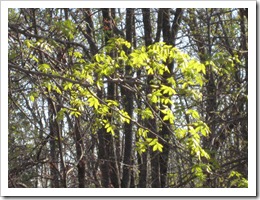
“What a beautiful day it is!” I told my wife as we drove out to the property today. “You already said that,” she informed me.  Yes, so I did. But what a beautiful day it was. Around here, the red bud blooms wild in the woods, followed by dogwood. Couldn’t see any dogwood (white blossoms), but the red bud was clear to see.

Red buds in bloomOaks beginning to leaf outThe oaks are just beginning to leaf out. Please indulge me for a one more picture. This is looking northeast from the west end of the property.
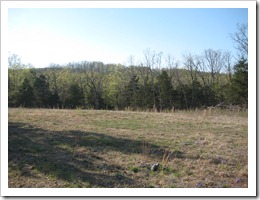
Dove MountainThe little hill you see is known locally as Dove Mountain. The use of the word mountain is strictly an Ozarkian term that means little hill slightly higher than the other little hills. Hey, it’s all we have out here. Anyway, it’s reported to be the second highest point in Missouri and is the vestige of an old volcano. You can still find plenty of volcanic rock in the west end of my property.