Tuesday, May 24, 2011

Garden and Roof

We took a bit of time and planted our garden. It was late (10th of May), but with all the rains, it was the soonest we could do it. We planted beets, bush beans, squash, lettuce, carrots, some watermelon seeds we had left over from plants that grew in our yard a couple years ago, tomato plants, and some old corn seed.

 IMG_2316 IMG_2317


We planted the beans and beets in the raised beds. The blackberries are doing fine. The squash was the first to come up. Everything but the watermelon and corn has come up.

Back to the house: Me and my helper started putting up the roof decking, but then he had to work at another job and I didn’t know if I could do it alone. Connie and I picked up the sheathing and as you can see, she did great. Just look at those muscles!

IMG_2318

IMG_2319


Well, after a few sheets, I was feeling overwhelmed. It didn’t seem this hard the last time we did a roof (but that was 20 years ago). Connie solved the problem by insisting I hire a roofer. I found one and he did a wonderful job with finishing the decking and the roof.

 IMG_2321IMG_2328


As you can see, we decided to go with shingles (Heritage architectural 30 year) rather than metal “ag” panel. Here’s the rationale: 1) metal is not cheaper than shingles, after you figure all the metal trim, contrary to what I originally thought; 2) metal is not maintenance free, even though it has a 45 year warranty (you will definitely need to tighten or replace the screws within 10 years); 3) insurance companies do not readily replace metal, even with hail damage, or dents, but they do readily replace damaged shingle roofs; 4) it’s easier to hide imperfections in the roof, such as out of square, with shingles; and 5) I really think shingles look better.

If I could afford standing seam, at $180-200 a square, I’d go with that, because that really is superior. But I can’t, so heritage shingles was the way to go for me.

IMG_2333

IMG_2330


IMG_2343And there it is. We stained and put on the fascia board and trim on the rake before the shingles went down. Next is to finish the sheathing and house wrap, in preparation for the doors and windows.


IMG_2345IMG_2347


Oh yes, we also finished the door and window bucks and cut the sheathing around the edges.

Monday, May 9, 2011

Trusses and Roof Decking Started

Last week, we finished the wall framing and put up the roof trusses. We’re now working on the roof decking. Roofs are hard! That’s my official position.

IMG_2293

IMG_2294


The first truss. We hired Art, who owns a sign company in town. He also lifts trusses on the side. I considered doing this step by hand, but decided against it when I thought through it. It was worth the $285 he charged me to come out and set them in place. We have two gable trusses and 14 common.

Before putting up the first gable truss, we installed long 2x4’s to the east side of the house extending up above the top plate to give the gable something to rest against.

After putting up the first four trusses, we stopped and braced them with a) a diagonal from the top tip of the gable truss to the bottom of the fourth truss, b) two diagonal braces from the bottom corners of the gable truss to the top ridge of the fourth truss, and c) a “rat run”, which consists of 2x4’s nailed across the top of the bottom cords of each truss. You’ll also notice the 2x4 blocks we put between each truss near the top to ensure proper spacing. These were 22-1/2” long and we used the same size blocks to space the bottoms of the trusses before nailing them to the top plate.

And here’s the part where I went wrong: The hoist guy came a little early and I was not ready. Feeling rushed, I failed to mark the top plates at 2 feet on center and instead decided to rely on the blocks for spacing. What I didn’t figure was that the trusses had nail plates at the corners right where we were placing the blocks for spacing and these nail plates were about a 16'th of an inch thick. Consequently, over the length of the building (30’), we gained an accumulated extra 2 inches of space between the trusses. This was a problem when we started nailing on the roof decking when we found the trusses were not exactly 2-foot on center. So, we had to start using nailers face-nailed to the top cord of the truss to compensate. Not the end of the world. After the roof is covered, and the sheet rock is installed, no one will know the difference. Just a word to the wise: Take the time to mark the top plates.

IMG_2295

IMG_2298


I love the shadows cast by a trussed roof. We were about half way done here.

And another word to the wise: Put a reference mark at one end of each truss before lifting them into place. Because I couldn’t rely on the top plate of the back wall being perfectly straight (although we tried), I struck a chalk line the full length of the top plate five inches in from the building line. I then placed a mark five inches in from the end of the bottom cord of each truss to use to line up the truss right on the chalk line. I missed one of the trusses and mistook a dark spot on the wood for the mark and ended up placing one truss about a half inch in (away from the mark on top of the eave wall), so it was not lined up with the other trusses. I didn’t find this error until we were about done with the roof framing. Because I couldn’t live with knowing it was off, and because it would have affected the decking, shed roof, and fascias, we cut all the nails holding the truss in place and shifted it over to match up. I’m sure I’ve built this entire building twice with all the rework. Mark well and avoid this kind of mistake.

IMG_2296

IMG_2304 


I had some good help. Here’s Bryce showing me his “owie”, which he courageously won involving a nail and a thumb (hey, that rhymes). Jason and Cameron (not shown here) were my other trusted and very much appreciated helpers. Just a note that Jason won his purple heart the next day when his left index finger got between a hammer head and the intended target. Ouch.

IMG_2305

IMG_2306


There’s Cameron (on the far end of the last gable truss). Here we are putting up the last truss. On the advice of Art, who’s done this a few times before, we put the wall sheathing on the last truss before we installed it, which saved a lot of time. We also repeated the same bracing on this end as we did on the other end.

IMG_2308

IMG_2309


The next couple of days, we framed the shed rafters and ceiling joists over the front of the building (notice the change of pitch on the front), installed the lookouts (2x4’s extending from the first common truss, through a notch in the gable truss, and out past the building line to receive the “barge” rafters), the barge rafters themselves, the sub-fascia on the front and back of the house, and started putting up the roof decking.

I know I over-build and I know I’ve not done things as efficiently as a professional. That’s a given. I’m trying to improve, because it takes so much time and effort to do anything, I really need to cut down on as many steps as possible. That being said, I always install 2x4’s on the end of the rafter tails as a sub-fascia, and as barge rafters. Then, I install the trim boards, which are 1 x lumber, wider than the 2x4’s, and extend down past them about 3/4”. It is possible to use the final trim boards as the fascia and barge rafters, but I just seem to feel better with doing structural framing first. Maybe I’ll change my mind, given how much work it is putting up these pieces, but that’s where I’m at now.

IMG_2310

IMG_2311


I rented a material lift from a neighbor to hoist the 4x8 sheets of roof decking. I was expecting (or hoping) to finish the roof framing by Saturday morning and then use the lift while installing all of the roof decking. But, surprise, it took longer than expected to frame the roof. We didn’t even get started on the decking until about 7:00pm. So, by the time we got two rows of sheets up on the back, it was starting to get dark. I only had the lift until Monday morning and I don’t work on Sunday (my Sabbath). The only thing we could do is frame some supports on the roof and lift as many of the sheets as we could. It was starting to get a little dicey putting up the front stacks, as it was getting dark, and Jason had to use a flashlight on his hand so I could see his signals. I finally called it quits after that, even though we still had about a dozen sheets on the ground. I’ll just have to lift those myself the old-fashioned way.

So, I feel some pressure to finish installing the decking, cut off the sheets ends, and order the metal. However, I will be looking for a good roofing contractor to possibly do the metal roof (that’s what Connie wants, since she said she’d rather the roof take longer and have me with her than finish the roof sooner and be alone). It’s starting to take shape.

Saturday, April 30, 2011

Framing Continues

 IMG_2267 IMG_2272


We framed the porch, using pressure treated 2x10’s. The ledger board to the right is attached to the house using 1/2” x 6” lag bolts, 2 between each joist. The beam, shown on the left, is a bit too massive, but I had to build it out to match the building line, since the posts for the porch beam would be bearing on them. I installed aluminum flashing over the beam and then nailed a 3/8” PT plywood over that, just to ensure if water did get under the porch floor, it won’t hurt the beam.

IMG_2274

IMG_2281


Here you see the porch completed. We put Avantec 3/4” plywood over the joists. Again, I used flashing along the edges of the joists for moisture protection. This is patterned after classic porches, with a solid floor and railings. It is higher maintenance using a solid floor rather than just decking spaced with gaps (I may have to paint the floor each year), but a porch is a very important element to me and the sold floor is a nice touch to this outside room.

IMG_2277

IMG_2283


As we put together the inside walls, we put up the top plate, using 2x10’s. With this top plate, door and window bucks made out of the same material, and the interior walls going up, it became apparent that this is one grossly over-built and incredibly strong building. As I said in an earlier post, I do tend to overbuild. Still, lumber is by no means the most expensive part of building a house. So, I build to last: through winds, storm, and earthquake, and maybe the occasional nuclear event.

IMG_2271

IMG_2285


Here’s a couple of detail shots of part of the wall. It shows the double 2x4 construction with air space between the inner and outer walls. It also shows how the windows (and doors) were framed to be in the same space in both the walls. I put headers (2x12 for windows and 2x10 for doors)  only in the outer walls, since that is what’s bearing most of the weight.

IMG_2269


This is a window buck completed, which further ties the inner and outer walls.


IMG_2286

IMG_2282


And here’s the completed top plates and a shot of the house as it stands now. I’ve used up almost all of the 325 2x4’s, all of the 2x12’s, most of the sheathing, and a good chunk of the 2x10’s.

Next: Trusses will be delivered Tuesday. Hope to have this dried in by end of next week.

Sunday, April 24, 2011

Putting Up the Walls and Building Up the Garden Area

We’ve resumed building on the house again, as Spring returns. It’s been raining a lot so now that we have the time and money, the weather is a challenge. Pretty typical for this time of year.

Surviving Winter

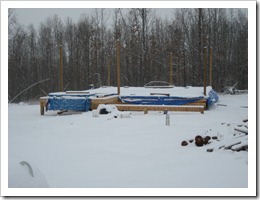
I wanted to post a couple winter pictures showing the house all bundled up waiting for the thaw: This was one our snow storms in January 2011. We don’t get a huge amount of snow, but it was still a long winter.
007

001


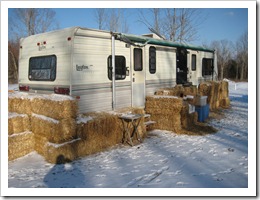
You can see our hillbilly hotel with the straw around the foundation to keep us a bit warmer than outside. Despite this and other precautions, the water line did freeze when we forgot to keep it trickling.

Floor

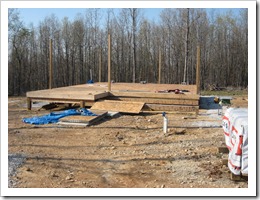
Winter finally did pass and I removed the plastic, since it seemed to keep the floor from ever really drying out. So now the rains have come and I’ve just given up on trying to keep it dry. It will do what it will do.
074

076


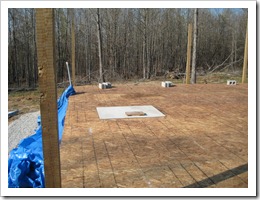
I think the floor has swelled relatively evenly, so the subfloor is now an inch thick rather than the original 3/4”. (Should have used Aventec instead of standard OSB, as mentioned in an earlier blog entry.)

We finished the floor and prepared to do the outer walls. Notice the foundation for the masonry furnace. Also, you can’t see it, but the posts have warped out of plumb over the winter, which will make putting up the walls a more difficult task. Yeah! Another challenge.

Outer walls

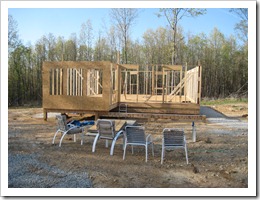
A few of my friends from church and a neighbor family came to help me put up the outer walls. I had pre-built a few of them and they helped me lift those and build the rest.

095

098


This wall was built prior to the “party” along with sheathing it on the floor, which is much easier to do, but results in a much heavier wall. I wanted to sheath this one first to ensure it stayed square, being the first wall.

100

105


This is the long East wall. We laid this out,  built it, and put it up in about an hour. It was threatening to rain and my crew was needing to leave, so we hurried and finished this. At the end of the day, we had put up the walls on three sides.

The next day, Connie and I built and put up the wall on the west side. It was easier and lighter because it only had one door and I waited to actually nail in the header until we got the wall up.

However, as it turned out, I put the door in the wrong place and had to move it over about 5 inches the next day, which is not too hard to do when it’s just framed.  

Inner Walls

I want thick walls to attempt to super-insulate this house. I decided on double 2x4 walls rather than, say a single 2x6 wall for several reasons: First, I wanted more insulation than would fit in a 2x6 wall, which is roughly R-19. Second, because I introduced 5x5 posts extending into the ground and through the walls, and since I added a couple of rim joists beyond the posts, I needed thick walls to enclose the posts into the wall. Finally, I wanted to avoid thermal bridges by offsetting the studs in the double 2x4 wall. As it turns out, I won’t have to offset the 2x4’s in the inner wall from the outer wall because of the dead space between them.

My design calls for an 8-5/8” wall (framing members only). I’m considering just making that 9-1/4”, or whatever a 2x10 is, avoiding having to rip 140’ worth of 2x10’s. I plan to blow in cellulose into the walls and in the attic. Cellulose has an R-value of 3.7 per inch. So, if I go with the 9'-1/4” 2x10 walls, they will have an R-34 insulation value. Certainly overkill for this climate (Ozarks, or southern Missouri), but I overbuild. That’s what I do.

I’ll do the inner walls and finish the sheathing this next week (if we get enough hours without rain).

Compost Bin

Here I am building the compost bin. Strange how I always get in the picture when Connie takes it. We felt it important to take a small detour from building the house to finish at least one compost bin. I used cut trees as some of the posts and got some old barn wood from a friend who owed me a favor. Don’t look too closely or you’ll notice I used some left-over 5x5 pressure treated lumber. Probably not the best thing to have in close contact with the compost I’m planning to put on my garden, but I justified it in my mind, because they aren’t using copper arsinide any longer, it was easier using square posts, I only had to cut 4 posts for the compost instead of 8, and I already had paid for them. Cheap beat green this time around.

072

081


  This is the first bin completed. There will be another bin on the near side. The middle bin will eventually be covered with a roof and will contain hay, or other cover material for the compost. I’ll also be extending the roof towards the back for another covered bin where we will keep saw dust. 

Garden

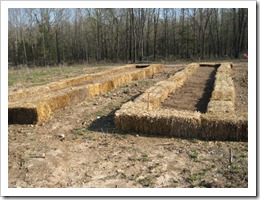
We also felt it important to get the garden started, at least part of it. We took the hay bails that were around the base of the trailer and made two raised beds 4’ x 40’, spaced 10’ apart. I then had a load (16 yards) of top soil brought in. When I rented the skid steer to drill the post holes for the compost and the vineyard/berry rows below, I moved the top soil into the raised beds. Connie and I then smoothed the dirt. We’ll be planting this week.
082

083 


We transplanted 16 thorn-less blackberry plants from our previous house. These came from a family at church who had been raising them for some time. We loved the the berries and they produce well. So, we made sure we dug some up before we left and planted these last fall. They are doing well, except for a couple of plants that didn’t make it. They will proliferate well enough, so I’m not concerned.

We also ordered and planted two Concord and two Reliance grape plants, as well as four disease-resistant apple trees (not shown). We aim to produce all our own food, eventually.

Hail Storm

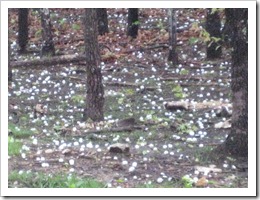
We were sitting in the trailer yesterday when suddenly we heard this CRASH and then another SNAP, THUD, BANG, with increasing frequency until it was as loud as, well, as HAIL. It didn’t last long, thankfully, but occurred twice in the afternoon. We took these pictures just after the first storm. The hail appeared to be as large as ping pong balls. Today I noticed it did ding our truck hood (and probably the top). Oh, well. Not to worry. The dings will just add contrast to the scratches.
108

110 


We will probably have storms all night again and then we are expecting, and looking forward to, some sunny weather again.

Saturday, March 12, 2011

How I’ve Spent My Winter

I mentioned software development. I’m a software engineer and for the past several years, I’ve been building, deploying, improving, and maintaining an electronic medical records system that is used to manage patient care in a medical clinic in rural Kenya—Africa, that is.

The clinic is located in the Mbirikani Group Ranch, a reservation-like location for the indigenous people of Kenya: the Massai. The clinic was founded and is maintained by AID Village Clinics, funded by a philanthropist in Chicago.

We put version 1.0 of my product into production at the clinic in May 2007. Since then, I’ve been working on version 2, which includes some major upgrades, including drug inventory tracking and prescription printing. Finally, in February of 2011, we deployed version 2. I just got back a week ago.

So, it’s been ok that the weather’s been bad and we haven’t had the money to proceed on the house, since I’ve been spending every waking minute for several months finishing this version and preparing for deployment. And now, it’s done. There’s still considerable work left over, but at a much less frenetic pace.

I wanted to share some pictures of my trip. More later.

AcaciaTreeAndKili


FlyBy


Killi


MeAndJonathan

Friday, December 31, 2010

Winter Delays

Cold weather, rain and snow, and lack of funds have pretty much stopped our progress on the house. We were able to get most of the sub-floor laid over the floor joists. More on that in a minute.

Here’s a picture of the pump house, the most “built” building on our property. Still not done, but functional.

IMG_2133

It was a very good thing that we stopped working on the house and built this when we did. It’s now December 31, 2010. We’ve been in the trailer for four months now and I don’t know what we would have done had we still been hauling water. I insulated the pump house pretty thoroughly. Along with the help of a heat lamp on a thermostat, it stays pretty much above 50 degrees in there. I’m also glad I made it a bit bigger (5’ x 6’) than it needed to be. If I had to do it over again, I would have made it even bigger.

We put bails of hay around the outside of the trailer to try and combat the cold. The floor is always cold anyway, but I think it helps.

IMG_2127

A friend of ours stopped by and said “It’s kind of hillbilly but it looks like it works.” Yep, we’ve focused pretty much on the practical and what works rather than aesthetics. Living on the edge, as it were, quickly lets you see what’s really important and what’s not.

Now back to the floor. When I purchased the sub-flooring material, I had a choice. Around here, and probably everywhere else in the country, most builders use Avantech, which is an OSB plywood product that is pretty much water-proof and costs about $25 a sheet. This is important when it rains before you get the roof on. Regular OSB plywood, which only costs about $15 a sheet, tends to soak up the moisture and swells. As you might have guessed, I didn’t use Avantech, but decided that instead of spending the extra $300, I would just put a tarp over the floor until we could dry-in the house.

WRONG. The tarps I used, it turns out, were not water-proof. And the older the tarp, the less water-proof it becomes. Here’s a picture of where we’re at now:

IMG_2131

It looks covered, but under the tarp, the OSB is pretty wet. And when normal OSB gets wet, it swells, especially on the edges, as you can see:

IMG_2132  So now what? Connie and I have thought we might have to tear it up and re-do the sub-floor with Avantech, which we still might do. However, this kind of thing happens to the builders who still aren’t using the good stuff all the time. I did some reading on-line and found others who were concerned as I was.

First of all, the structural integrity of the plywood is not compromised by rain or moisture, unless it sits in water for some time. Secondly, the swelling that does occur is usually sanded down before applying any flooring treatment. The edges swell the most, but it seems that a good floor sander could handle the problem. A link I found helpful:

http://www.askthebuilder.com/304_Plywood_and_OSB_-_Which_One_Is_Better_.shtml

So, it is possible to recover from this kind of moisture problem. Frankly, I’m not sure if it would have been better to leave the floor exposed rather than covering it with the tarp. My concern is that the moisture trapped under the tarp may take longer to dry. But, it is what it is. I’m not taking the tarp off until I’m ready to dry in the building.

The other reason I should have used Avantech was to make the next step of drying in the building easier. With OSB needing to be kept as dry as possible, I’ve felt we should wait to proceed until we have the money, materials, and man-power lined up to get it done as quickly as possible. As soon as I remove the tarp (assuming it’s doing any good), we need to put up the walls and sheathing, place the trusses, and finish the roof in one swift move. If I had used Avantech, I wouldn’t feel quite so much pressure for speed. So, the extra $300 sounds like a bargain at this point.

Incidentally, regardless of what is used for sub-flooring, especially if standard OSB is used, the building should be allowed to dry after the roof is on before proceeding with any finish work.

So here we are, stuck in winter, stuck in a 30’ trailer, bumping into each other and waiting for a break in the weather and enough money to pile up to buy the materials for drying-in the building, which I think will cost about $4,000-5,000. In the meantime, I’m busy with my software development work and studying to take the ham radio technician class FCC test. I’m gonna’ be a ham. Also, our branch of the church has an orchestra! We’ve become involved with Connie picking up the viola again (which she played as a youth) and me conducting and arranging pieces. I’ll try and post some music that I’ve arranged (using the Finale PrintMusic program) in the future. Cool stuff.